Tendon Pain Explained: Healthy Tendons, Tendinopathy and How We Rebuild Them
PART 1
Achilles pain. Tennis elbow. Jumper’s knee. Pain at the side of the hip. Rotator cuff problems.
These conditions may look different, but they all have something in common: they all involve tendons.
Tendons are remarkably strong structures. They transfer force from our muscles to our bones and have an impressive ability to adapt to exercise, allowing us to walk, run, jump, lift weights and play sport.
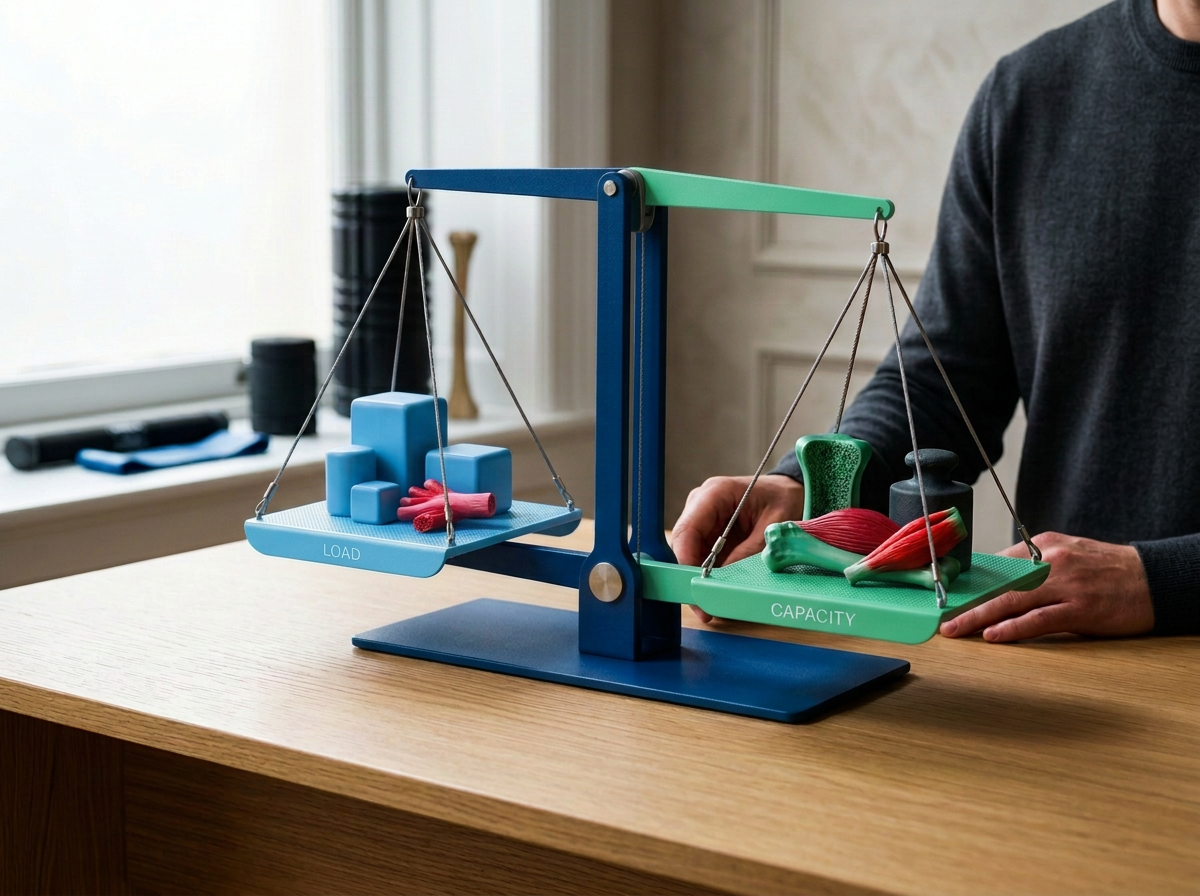
However, problems can develop when the demands placed on a tendon are too high, and its current ability to cope with them is too low.
Understanding the link between load and tendon capacity is one of the most important parts of understanding tendon pain.

Volleyball player jumping for a ball
What does a healthy tendon do?
Describing a healthy tendon as just a piece of tissue connecting muscle to bone would be a huge understatement.
It is a highly specialised structure designed to deal with force.
When you run, for example, the Achilles tendon has to accept, store and release large amounts of energy with every stride. When you lift a weight, the tendons around the shoulder and elbow transmit force generated by your muscles every time you lift or lower the weight.
Importantly, tendons adapt to load.
However, it must be an appropriate amount of exercise followed by sufficient recovery in order to become better at dealing with that load.
Problems usually arise when there is a mismatch between:
The amount of load placed through the tendon
and
The amount of load the tendon has capacity to tolerate.
This concept is what drives modern tendon rehabilitation.
What is tendinopathy?
You'll often hear several different terms used to describe tendon problems:
Tendinosis
Tendinitis
Tendinopathy
Tendon tear
They don't all mean the same thing.
Tendinosis
Tendinosis is a term traditionally used to describe degenerative or structural changes within a tendon.
The difficulty is that tendon structure doesn't always match with tendon pain.
Some people can have significant structural changes on a scan and very few issues (if any). Others can have a great deal of tendon pain without major imaging abnormalities.
This is one reason why we should treat the person and their function. Scans often don't tell the full story, as everyone is different and functions differently.
Tendinitis
The “-itis” part means inflammation.
Historically, persistent tendon pain was commonly labelled tendinitis: Achilles tendinitis, patellar tendinitis, rotator cuff tendinitis and so on.
We now know that persistent tendon problems are typically more complex than just tendon inflammation.
For this reason, tendinopathy is usually a more useful term for persistent load-related tendon pain.
Tendinopathy
Tendinopathy is the broader clinical term we commonly use for a painful tendon that has become less able to tolerate the demands being placed upon it.
Professor Jill Cook and colleagues have stated tendon pathologies are beyond just sitting in specific categories, describing more of a pathology spectrum.
A tendon may transition from a healthy state towards becoming reactive, from reactive to a state of disrepair and eventually towards more chronic wear and tear.
Bear in mind: pain, tendon structure and function do not always transition together.
Our rehabilitation goal, therefore, is to help the tendon become less painful, stronger and capable of doing what you need it to do.

What about a tendon tear?
A tear means that some of the tendon fibres have physically disrupted, ranging from a relatively small tear through to a complete rupture.
A classic example would be an Achilles rupture while sprinting or playing sport. Someone may describe suddenly feeling as though they have been kicked or struck in the back of the leg, despite nobody being behind them.
A tendon tear is different from tendinopathy, although the two can sometimes coexist. Other tendon tears can develop within a tendon that has already undergone structural change over time.
Therefore:
Tendinopathy = a tendon struggling to tolerate load.
A tendon tear = disruption of tendon fibres.
They require different clinical considerations and sometimes different management.
Why does tendinopathy develop?
One of the most common stories we hear in clinic is:
“It just gradually started hurting out of nowhere.”
That is very different from many acute tendon tears.
Tendinopathy commonly develops following a change in load.
For example:
Suddenly increasing running mileage
Adding more hill running
Increasing sprinting or jumping
Returning to sport after a period away
Starting a new gym programme
Rapidly increasing weights
Playing considerably more padel or tennis
Increasing training frequency without sufficient recovery
Returning to exercise after illness or injury
The important word here is change.
Someone may have run 20 kilometres each week for years easily. If they suddenly increase to 40 kilometres, the tendon is being exposed to a workload it hasn't had time to adapt to.
Similarly, somebody may previously have tolerated heavy exercise perfectly well, but after a prolonged break their tendon capacity may have reduced, meaning the old training programme can effectively become a new load.
Research into tendon pathology also suggests that repeated high-load energy-storage activities and compression can be particularly provocative for some tendons.
Individual factors such as age, biomechanics and general health can also influence tendon capacity.

Load isn't the enemy
This is one of the most important messages we give patients.
If excessive load can aggravate a tendon, then completely resting it looks like it makes sense at first.
Unfortunately, even though prolonged rest may reduce the pain temporarily, it may also reduce the capacity of the muscle and tendon further, which won't solve the underlying issue.
This means, therefore, the answer is usually not:
NO LOAD.
It's:
THE RIGHT LOAD…which we will go on to discuss in part 2.
Struggling with persistent tendon pain?
At PhysioHub, tendon rehabilitation is an area we're particularly interested in.
Tom O'Sullivan and the PhysioHub team assess and treat tendon problems including Achilles tendinopathy, plantar heel pain, patellar tendinopathy, gluteal tendinopathy, rotator cuff problems, tennis and golfer's elbow and other persistent tendon conditions.
Treatment starts with understanding why your tendon has become painful and what it currently can, and can't, tolerate.
From there, we can build a rehabilitation programme tailored to you, incorporating load management, progressive strengthening and, where appropriate, treatments such as manual therapy or shockwave therapy. The goal is to build your tendon back up for what you want it to do, not just get rid of the pain.
PhysioHub clinics are based at:
David Lloyd Manchester North, Middleton
The Moorside Clinic, Heaton Moor, Stockport
If tendon pain is stopping you from running, training, playing sport or simply doing the things you enjoy, book an assessment with Tom and the PhysioHub team.