
Shin pain in runners – to run or not to run?

Shin pain in runn
Shin pain is one of the most common injuries affecting runners — from beginners starting couch-to-5k programmes to competitive athletes chasing PBs.
At our running physio clinics in Stockport (Heaton Moor) and Middleton , this is one of the most frequent questions we hear:
“Should I keep running — or should I stop?”
The answer is rarely black and white.
Understanding when it is safe to run — and when rest is essential — is critical for preventing progression to more serious injuries such as stress fractures.
What is shin pain in runners?
The most common diagnosis is medial tibial stress syndrome (MTSS), often known as shin splints.
This condition causes pain along the inner border of the tibia due to repetitive loading exceeding the bone and soft tissue’s ability to adapt.
Shin pain is particularly common in runners due to:
Sudden increases in training load
Running on hard surfaces
Biomechanical factors
Inadequate strength or recovery
Systematic reviews confirm that MTSS is a frequent overuse injury in both novice and recreational runners.
So… should you run or rest?
The most evidence-informed approach is load modification rather than complete rest — unless symptoms are severe.
Clinical research into shin pain rehabilitation highlights the importance of:
managing training load
addressing contributing biomechanical factors
progressive strengthening
graduated return to running
These components form the basis of best-practice physiotherapy care.
A simple traffic light guide for runners
We use a traffic light system in clinic to help runners decide whether they can continue running safely.
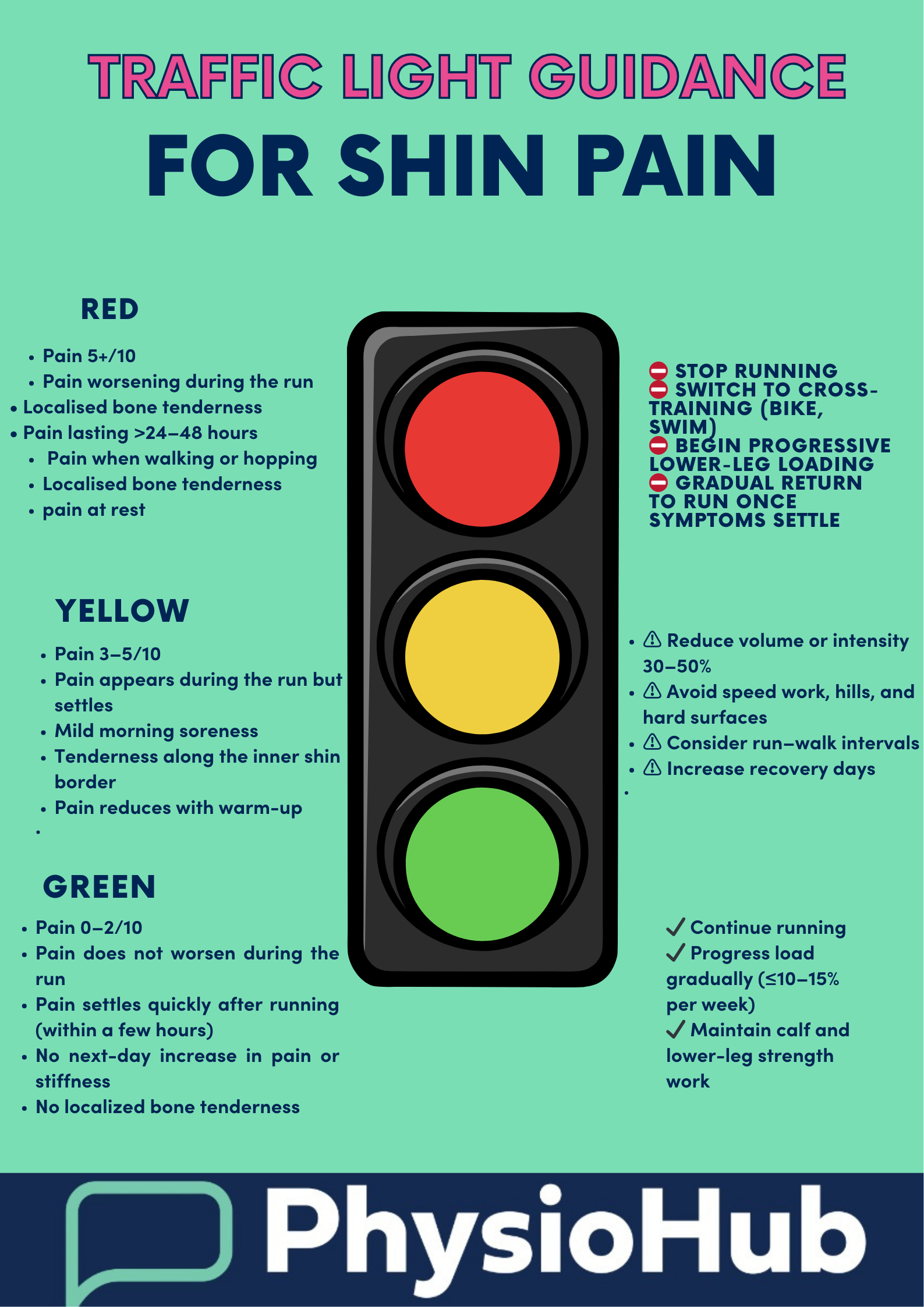
traffic light system for shin pain in runners. When to run or rest.
Figure1 : Traffic light guidance for shin pain developed by PhysioHub running physio team
🟢 Green light — safe to run
It is usually safe to continue running if:
Pain is mild (0–2/10)
Pain does not worsen during the run
Symptoms settle quickly afterwards
There is no increase in pain the following morning
At this stage, continuing to run can help maintain conditioning and confidence.
Progression of training should still be gradual. Interestingly, research has shown that simple training load rules (such as never increasing more than 10%) may not reliably predict injury risk in runners.
This reinforces the importance of individualised physiotherapy guidance.
🟡 Yellow light — modify running
Runners should consider reducing training load when:
Pain appears during the run
Morning stiffness increases
Tenderness develops along the inner shin
At this stage, strategies may include:
reducing volume or intensity
introducing run-walk intervals
avoiding speed work
increasing recovery days
Evidence-based return-to-run guidelines emphasise progressing distance before speed and intensity, while closely monitoring symptom response.
🔴 Red light — stop running
Running should usually stop if:
Pain becomes sharp or localised
Symptoms worsen during the run
Pain persists for days
Pain is present with walking or hopping
These signs may indicate a tibial bone stress injury, where continuing to run could increase the risk of stress fracture.
In these cases, a structured physiotherapy rehabilitation programme is essential.
What actually helps shin pain recovery?
At our Manchester running physio clinic, treatment typically focuses on:
✔ Load management
Adjusting running frequency, intensity and terrain.
✔ Strength training
Improving calf capacity and lower-limb stiffness.
✔ Running biomechanics
Modifying stride length or cadence can reduce tibial loading and improve symptoms.
✔ Progressive return to running
Using objective strength and pain criteria rather than fixed timelines.
Research consistently highlights that rehabilitation programmes addressing multiple factors lead to better return-to-running outcomes.
When should you see a physio?
You should consider seeing one of our running specialist physios in Stockport or Middleton if:
Shin pain persists for more than 1–2 weeks
Pain is worsening despite reducing training
You cannot complete normal running sessions
There is focal tenderness or hopping pain
Early physiotherapy assessment can help prevent minor shin pain progressing into more serious bone injuries.
Final thoughts
Shin pain does not always mean you must stop running.
But ignoring symptoms or pushing through worsening pain can significantly prolong recovery.
Using a simple traffic light approach — combined with expert physiotherapy guidance — allows runners to stay active while reducing injury risk.
If you are struggling with shin pain and want to return to running safely, working with one of Physiohub’s specialist running physios in Stockport or Manchester can make a huge difference.
Need help with shin pain?
At PhysioHub we specialise in:
Running injury physiotherapy
Return-to-run rehabilitation
Biomechanical running assessment
Performance-focused injury management
Book an appointment at our physio clinics in Stockport or Middleton to get back to running with confidence.